Penultimate Units
Penultimate units are extremely simple, versatile, and rigid. They are perfect for creating sturdy, exact models of most polyhedra. The original creation is by Robert Neale.
Base Unit
Materials: Only paper is needed. Using standard letter-sized paper, fold diagonally and cut out the largest possible square. Divide this square into 4 smaller squares. Each unit will use one small square.
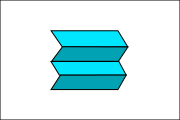
Step 1. Fold the paper into quarters in a wavelike pattern, as shown. Collapse it, and you should end up with a flat 1x4 horizontal strip.
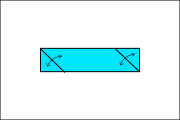
Step 2. Fold the entire top right corner down (all flaps) to meet the bottom edge, as shown. Similarly, fold the entire bottom-left corner up.
(For advanced folders, fold ONLY the top flap if you are folding square or hexagon modules.)
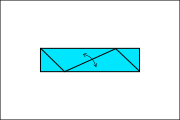
Step 3. Connect the top and bottom crease endpoints created in Step 2 using a valley fold.
Variations
At this point, you have already finished the pentagon module. See Assembly section to create a dodecahedron using 30 of these modules!
However, the power of Penultimate modules is that you can create various different polygons using variations of the same base unit. In fact, it's often necessary to create different variants on the two ends of the same unit. Linked below are module extensions for the triangle, square, and hexagon.
(Note: Some of the variations may require scissors, but I prefer circumventing it using inside folds because it preserves the artistic purity of origami :))
With a bit of trigonometry knowledge and a calculator, you can actually easily design your own variations to fit your needs. I encourage you to check out the math behind piece design page to see some more unusual variations designed by myself.
(The linked page is currently under development. Sorry for the inconvenience!)
Assembly
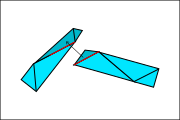
To put pieces together, simply insert the end of one piece into the pocket of another. Make sure that the two red creases coincide after you insert.
Shown on the right are pentagon units, but all other variations work analogously.
To create a polyhedron, just connect many units together while adhering to the polyhedron's structure. Remember that each Penultimate unit is an edge of the polyhedron. Feel free to explore our interactive 3D polyhedra visualizer if you're stuck.
(This visualizer is also still under development.)